.

ad test

Showing posts with label Military. Show all posts

Wednesday, November 15, 2017

Mixed Emotions

After Morgan Tsvangirai won the first round of Presidential elections in Zimbabwe in 2008, I followed developments there hoping for a peaceful transition to democracy for a few years before throwing in the towel.

I figured that nothing would change, and I felt that I had nothing to add.

Well, it appears that the Zimbabwe Defence Forces have deposed Robert Mugabe in a coup.

I'm not sure if this actually constitutes a change, or if it will lead to change:
Zimbabwe — After ruling Zimbabwe for nearly four decades, leading the country from the triumph of its independence struggle to economic collapse, the world’s oldest head of state became a prisoner of the military he once commanded.

Robert Mugabe, 93, was detained along with his wife, according to a military announcement Wednesday. The move appears to end one of Africa’s most controversial political dynasties while raising questions about what might come next — military rule, a transitional government or a settlement that would allow Mugabe to return to power.

No matter what happens, this appears to be a watershed moment for Zimbabwe and southern Africa, which have suffered from the tumult of Mugabe’s reign, even as his hold on power sometimes seemed unshakable.

Zimbabweans awoke early Wednesday to a televised announcement from an army general promising that there was “not a military takeover,” although Mugabe had been detained and armored vehicles were rolling into Harare, the capital.

………

Mugabe recently purged some key officials from the ruling party, ZANU-PF, paving the way for his 52-year-old spouse, Grace, to succeed him. Many see that move as a major miscalculation, alienating Mugabe from the civilians and military leaders on whom he had long depended. 
Seeing as how the military is part and parcel of the corruption and human rights disaster that is today's Zimbabwe, I do not expect this to usher in an era freedom, prosperity, and democracy.

Thursday, November 2, 2017

Guantánamo is F%$#ed Up and Sh%$

It's always been clear that the military tribunals have as their primary goal the creation of the illusion of due process.

Most recently, defense attorneys involved in a capital case from withdrew from the case because their attorney-client communications were monitored.

The judge in the case has now sentenced the remaining lawyer for contempt after they refused to order the existing attorneys back to work.

Kangaroo court much?
The military judge presiding over the Guantánamo military commissions prosecution for the 2000 USS Cole attack confined the chief military defense attorney to his quarters for three weeks for disobeying orders, according to The Miami Herald.

The military judge, Air Force Col. Vance Spath, held Marine Brig. Gen. John Baker in contempt for refusing to rescind his decision permitting the three non-military defense attorneys in the death penalty case against Abd al Rahim al-Nashiri to quit for ethical reasons related to secret government eavesdropping on their communications. Baker was also held in contempt for refusing to testify about his decision.

The military judge said that Baker did not have the authority to make the decision and rejected Baker’s effort to explain that the military court has no jurisdiction over him.

“The contempt finding and confinement of General Baker is unlawful and an outrage,” said Hina Shamsi, director of the American Civil Liberties Union’s National Security Project. “General Baker was continuing the honorable military defense counsel tradition of trying to act ethically, despite being part of a system rigged against the rule of law. The military judge’s unprecedented contempt ruling against General Baker shows just how difficult that is. The military judge’s decision needs to be reversed and General Baker released immediately.”

The military judge has ordered the three civilian attorneys — Rick Kammen, Rosa Eliades, and Mary Spears — to participate in a hearing on Friday, setting the stage for another legal showdown.

Also today, in Washington, other attorneys for al-Nashiri asked a federal district court to stop the prosecution from going forward without an attorney specially qualified for capital cases, which is required by the rules of the Guantánamo military commissions themselves. The attorneys made two filings in court today, and a hearing is scheduled for tomorrow at 9:30 a.m. in the U.S. District Court for the District of Columbia.

“The whole prosecution of Mr. al-Nashiri has again gone off the rails, this time because of ethical violations caused by the government itself,” Shamsi added.
We really need to end this charade.

It servers neither the interests of justice, due or of due process, and it harms US security.

To quote George Clemenceau (Not Groucho Marx as is often erroneously attributed), "It suffices to add "military" to a word for it to lose its meaning. Military justice is to justice what military music is to music."

Saturday, October 28, 2017

And the Mistake Jet Cluster F%$# Continues

The F-35 was intended to be a major technical leap, not just in performance (it isn't), and not just in stealth (it isn't), but also in terms of its availability and maintenance overhead.

It turns put that it has failed the last bit as well:
The Pentagon is accelerating production of Lockheed Martin Corp.’s F-35 jet even though the planes already delivered are facing “significantly longer repair times” than planned because maintenance facilities are six years behind schedule, according to a draft audit.

The time to repair a part has averaged 172 days -- “twice the program’s objective” -- the Government Accountability Office, Congress’s watchdog agency, found. The shortages are “degrading readiness” because the fighter jets “were unable to fly about 22 percent of the time” from January through August for lack of needed parts.

The Pentagon has said soaring costs to develop and produce the F-35, the costliest U.S. weapons system, have been brought under control, with the price tag now projected at $406.5 billion. But the GAO report raises new doubts about the official estimate that maintaining and operating them will cost an additional $1.12 trillion over their 60-year lifetime.

Already, the agency said in the draft obtained by Bloomberg News, the Defense Department “must stretch its resources to meet the needs of continued system development and production while at the same time sustain the more than 250 aircraft it has already fielded.”
In addition to this, it has been revealed that the first 108 F-35s produced will never be combat capable, so something around $40 billion has been flushed down the toilet:
The new F-35 program executive officer, U.S. Navy vice admiral Mat Winter, said his office is exploring the option of leaving 108 aircraft in their current state because the funds to upgrade them to the fully combat-capable configuration would threaten the Air Force’s plans to ramp up production in the coming years.

These are most likely the same 108 aircraft the Air Force reportedly needed to upgrade earlier in 2017. Without being retrofitted, these aircraft would become “concurrency orphans” — airplanes left behind in the acquisition cycle after the services purchased them in haste before finishing the development process.

Left unsaid so far is what will become of the 81 F-35s purchased by the Marine Corps and Navy during that same period. If they are left in their current state, nearly 200 F-35s might permanently remain unready for combat because the Pentagon would rather buy new aircraft than upgrade the ones the American people have already paid for.

 What makes this particularly galling is the aircraft that would be left behind by such a scheme were the most expensive F-35s purchased so far. When the tab for all the aircraft purchased in an immature state is added up, the total comes to nearly $40 billion.
If you run the numbers, that is about $370 million for each of these hangar queens.

Imagine what could have done with that money.

Friday, October 27, 2017

Death Wears Fuzzy Bunny Slippers

It turns out that while waiting for the literal end of the world, nuclear crews spend a lot of time waiting ……… and waiting ……… and waiting ……… and waiting ……… and waiting.

Two guys a hundred feet underground for 24+ hours waiting for the call that they hope never comes.

One is watching the dials, and the other one gets comfortable and relaxed so that they will be sharp when his turn comes to watch the dials.

Snuggies and fuzzy bunny slippers are a not infrequent part of the latter regime, hence the most awesome unit patch ever.

Tuesday, October 24, 2017

Headline of the Day

Question the Generals? Hell, Yes
—The South Florida Sun Sentinel editorial board
This is in response to rather egregious behavior of the Trump administration in general, and former general and Chief of Staff John Kelly.

I think that we may be approaching some sort of tipping point on blind acceptance of military bullsh%$.

At least I hope that we are.

Monday, October 23, 2017

Item Number 1033 of Things that I Thought I Would Never Say*


Yeah, I cannot believe that I just said that, but everyone's favorite philandering self-important martinet just slapped down the Trump administration for saying that reporters should not fact check Trump's chief of staff, John Kelly, on his the lies that he spewed a few days back.
ABC's THIS WEEK host Martha Raddatz began her interview by asking Gen. Petraeus about this incident.

"I want to start with what the White House said, about it being highly inappropriate to debate a four-star general," she said.

Petraeus replied, "Well, I think we're all fair game." He continued, "We, in uniform, protect the rights of those to criticize us, frankly."
We live in strange times.

*The number one thing that I thought I would never say remains, as always, "It’s not buffet time at the Wildebeest."

This Dick Waving Is Going to Get Us All Killed

We now have reports that, for the first time since 1991, the United States Air Force will be putting nuclear bombers back on round-the clock nuclear alert:

The U.S. Air Force is preparing to put nuclear-armed bombers back on 24-hour ready alert, a status not seen since the Cold War ended in 1991.

That means the long-dormant concrete pads at the ends of this base’s 11,000-foot runway — dubbed the “Christmas tree” for their angular markings — could once again find several B-52s parked on them, laden with nuclear weapons and set to take off at a moment’s notice. 

“This is yet one more step in ensuring that we’re prepared,” Gen. David Goldfein, Air Force chief of staff, said in an interview during his six-day tour of Barksdale and other U.S. Air Force bases that support the nuclear mission. “I look at it more as not planning for any specific event, but more for the reality of the global situation we find ourselves in and how we ensure we’re prepared going forward.”
I am NOT feeling any safer right now.

Friday, October 20, 2017

Headline of the Day

Thanks, Obama: Trump Plans to Make It Easier to Kill Civilians with Drones

True dat.

Saturday, October 14, 2017

Israel Has 2Nd Thoughts about V-22 Acquisition


V-22s Range Advantage has a Cost
Israel seemed poised to purchase the tilt-rotor V-22 Osprey, and now they have put this on hold.

I am not particularly surprised.

The V-22 is a maintenance hog, and cost a fair amount to operate.

While the Osprey is about 100 kts faster, has a longer range, it can only carry about 1/3 of the payload, even though it has 2/3 of the installed power.

Additionally, unlike a conventional helicopter, the V-22 does not have a meaningful auto-rotation capability, and its performance with external loads is pathetic.

Israel simply does not have the need for the additional capabilities offered by the tilt-rotor:
The Israeli air force has frozen its evaluation of the Bell Boeing V-22 Osprey, with a senior defence source indicating that the tiltrotor is unable to perform some missions currently conducted using its Sikorsky CH-53 transport helicopters.

In January 2014, the US Department of Defense notified Congress about its intention to sell six V-22s to Israel. This followed an evaluation conducted by air force personnel, which led to the service seeking a rapid acquisition to support special operations. The proposed purchase met with opposition from elsewhere within Israel's defence ministry, however.

Other potential candidates to replace the Israeli air force's aged CH-53s by around 2025 include Sikorsky's new CH-53K and the Boeing CH-47 Chinook.
Simply put, the IDF does not have the requirements, such as amphibious landings from extreme distance, that have driven the V-22, and as such, it does not make sense.

Wednesday, August 16, 2017

TASS: Military & Defense - Russia’s 5th-generation fighter jet named as Su-57


Roll promotional video with cheesy music
The Sukhoi fighter jet, has had its name updated from T-50 (Basically the company's internal designation meaning the 50th delta wing model) to the official Russian military designation Su-57. (Also here)

I don't think that this means a whole bunch in the greater scheme of things, but have a promotional video for the 5th generation fighter.

It doesn't reflect much in the way of a change in the status of the aircraft:  It's still a limited production prototype, and the intended final engine is years down the road, but it does make for some decent videos.

Friday, August 11, 2017

Seriously Neat Tech

Spider silk has some remarkable mechanical properties. Its low weight, high strength, an low modulus make it a potential break through in body armor.

The problem is spiders, which produce the material in very limited quantities, and their cannibalistic proclivities mitigate against high intensity farming.

Well, it looks like the DoD is trying to get silk genetically engineered worms to produce spider silk an alternative:
The U.S. Army is upping its investment in genetically engineered spider silk for body armor. Last year, the service paid almost $100,000 to Kraig Biocraft Laboratories, which makes spider silk that can be produced at scale — with silkworms. On Wednesday, the company announced that the Army will move to the second phase of the contract and will look to Kraig to produce a customized strain of the silk for “high-performance fibers for protective apparel applications.” That is: flexible body armor made from genetically engineered spider silk. The total contract amount would reach $900,000 if parameters are met. Army representatives said that interested in the material purely from a research perspective, for now.

Kraig Biocraft injects spider DNA into silkworm eggs, enabling the worms to produce its custom silk. The researchers describe the process in this 2011 PNAS paper.

Spider silk is much tougher than regular worm silk, and about half as tough as Kevlar. But it’s far more flexible, (3 percent elasticity for kevlar versus nearly 40 percent for spider silk.) The Army believes that the energy absorption of the material could be much higher than kevlar (as determined by multiplying the strength of the fiber by the elongation.)

It’s also much more elastic and flexible than kevlar. But getting enough spider silk to clothe an Army is a tall order. The crawly arachnids don’t produce silk in high volume and when you crowd spiders too close together, they eat each other. The quest to produce spider silk in hosts other than spiders has led researchers to use a variety of other methods such as yeast, e. coli bacteria and mammalian cells. 
There is also the fact that the techniques for handling silkworms, and harvesting the silk, have been known for thousands of years.

It is also far less alarming than the prospect of an escape of motherf%$#ing mutant spiders.

Why the Military Should Not Be Used to Build International Relationships

………

Favoring the military over alternative tools of U.S. foreign policy remains one of the few consistencies within the current administration. Internal documents have proposed folding USAID into the State Department and “zeroing” out development assistance programs that do not advance specific U.S. political or strategic objectives. With few civilian appointees in either the Departments of Defense or State and unprecedented levels of “authorization,” the uniformed services enjoy tremendous operational discretion with few civilian counterbalances either inside or outside the Pentagon.

The trend of shifting foreign policy funds towards programs with an explicit security focus long predates the Trump administration. A third of all U.S. foreign aid funds, $17 billion, goes towards military aid and security assistance, making it on its own the fourth-largest foreign aid budget in the world. Moreover, management of this security assistance money has migrated away from the State Department to the Pentagon. A recent Open Society report shows that, whereas in 2011 the Defense Department directed only 17 percent of all security assistance (compared to the State Department’s 80 percent), by 2015 the Defense Department’s share had increased to 57 percent and the State Department’s had dropped to 42 percent. Officials wearing digicam rather than pinstripes are delivering an increasing percentage of U.S. assistance.

While the broad potential problems with this trend have been well–explored, in this article we focus on a concrete implication by looking at an important component of U.S. assistance: the training of other states’ militaries and security personnel, known as foreign military training (FMT). As in the case of Egypt, this training can empower its uniformed recipients to participate more in their home countries’ internal politics, up to and including coups.

………

According to the U.S. government, in fiscal year 2015 approximately 76,400 students from 154 countries participated in U.S. foreign military training, costing $876.5 million. Colleagues have recently argued that this sort of security assistance rarely achieves its stated goals of contributing to U.S. foreign policy objectives through “helping allies and partners improve their defense capabilities and enhance their ability to participate in missions alongside U.S. forces.” In contrast, we argue that in some cases, security assistance does have a profound effect, albeit in ways unintended by the donor. By strengthening the military in states with few counterbalancing civilian institutions, U.S. foreign military training can lead to both more military-backed coup attempts, as well as a higher likelihood of a coup’s success.

………

This might seem counterintuitive since the training provided to these officers is designed to encourage liberal values including respect for civilian control, a norm central to the U.S. military’s own identity. Moreover, the United States normally cuts security assistance when a coup occurs, which should deter military officers from attempting a takeover.

We argue, however, that the norm most likely to be transmitted by U.S. training is one to which foreign military officers are already receptive: a professional identity independent from that of their own government. The U.S. military’s distinct professional culture is largely based on Samuel Huntington’s notion of “objective civilian control.” This ideal precludes military interference by in politics, but it also generates a strong, separate corporate identity. Huntington himself recognized that, in countries that are not solidly established democracies, the more professional the military considers itself, the higher its temptation to intervene in political affairs.
This has been known for years.  The unsavory reputation of the School of the Americas, which led to its renaming in 2000.

Thursday, July 20, 2017

Epic Troll

Over at The Register, they discuss how the Royal Navy will maintain offensive capability now that they will have no antiship weapons between 2018 and 2020.

Their proposal is to put the biplane Fairey Swordfish torpedo bomber on their aircraft carriers:
The solution to the Royal Navy’s post-2018 problem of having no anti-ship weapons is already in service and can even equip the UK’s new aircraft carriers.

The Fairey Swordfish (pictured above) is a versatile, rugged torpedo bomber first introduced into service in the 1930s. Having outlived everything introduced to replace it during the WWII, two flying examples remain in service with the RN Historic Flight.

These two aircraft could each be assigned to HMS Queen Elizabeth and HMS Prince of Wales, the 70,000-ton aircraft carriers due to enter naval service in the near future.

Although neither carrier has catapults (or, indeed, aircraft until the year 2021), the Swordfish is capable of taking off within 540ft at full power* with the ship steaming into a 20kt wind – which compares very favourably with the QE-class’s 920ft flight deck.

The Swordfish has a noble and proud history of delivering the Navy’s ship-sinking capability, most notably over the Italian fleet at Taranto in 1940 and crippling the battleship Bismarck later in WWII. It is a proven war-winning platform with a straightforward wood-and-canvas construction that means spares and logistic trains will cost infinitely less than the heart-stoppingly expensive F-35B fighter jet (at around $130m per aircraft, according to some estimates) which will not be able to fly from the British carriers until 2021 at the earliest.
Snerk!

Friday, June 30, 2017

This Has Disaster Written All Over It


Theodore Roosevelt Full Ship Shock Test
The US Navy wants to defer shock testing on the Ford class carriers until the 2nd ship and got a provision in the latest defense appropriation bill allowing them to do this, because, after all, it's not like it's ever going to see combat, or have a weapons handling accident, or run aground, or collide with a garbage scow.

Seriously?

This ship has a new catapult and arresting gear using a new electromagnetic technology, a new reactor, a new radar, a different computer architecture, a new ordinance handling system, a modified hull, and increased automation to reduce crewing.

Any of these systems could be impacted very differently by shock than the legacy systems on the Nimitz class, and the Navy wants to deploy the first ship in class without testing.

This is simply insane.

Sunday, June 18, 2017

Neat Tech

The good folks at the Air Force Research Laboratory have been working on a radar that uses liquid metal to allow for on the fly reconfiguration:

The US Air Force Research Lab (AFRL) is building antennas using liquid metal to enable changes to the size, shape, and functionality of the electrical wiring.

Currently, the research effort is using gallium, which is known for its use in radars (gallium arsenide and gallium nitride types) and sensors.

"What we are doing here is using the gallium as a metal itself," Christopher Tabor, materials research scientist, AFRL, told Jane's at the US Department of Defense (DoD) Lab Day, held on 18 May at the Pentagon in Washington, DC.

"Gallium by itself melts at about 87° Fahrenheit [30.5° Celsius]. If you blend in materials like Indium it becomes a eutectic alloy that will melt at much lower temperatures," Tabor said. "So this is a conductive fluid below room temperature."

Pre-designed channels inside structural composites are filled with liquid metal to produce an embedded, physically reconfigurable antenna, according to AFRL.
We are all familiar with liquid metals, as the liquid metal in "Mercury" thermometers is now the alloy Galinstan, an alloy of Gallium, Indium, and Tin, and is a liquid from around between -19° and 1300°C.

The theory here is that you could have a series of channels and valves (or perhaps fluidic controls) that would allow a radar to change its shape dynamically, which would eliminate the need for actuators found in more conventional radars.

I call this neat stuff.

Sunday, June 11, 2017

Satire that Isn't

The noted satire military blog Duffelblog has an article on H.R. McMaster, the current US National Security advisor, whose PhD thesis argued that the Joint Chiefs of Staff engaged in dereliction of duty for not recognizing that the Vietnam war was fundamentally unwinnable is now saying that  there is a light at the end of the tunnel in Afghanistan.

Of course, everything is different this time:
The man who once wrote a book highly critical of policymakers who escalated an unwinnable war in Vietnam is urging escalation in an unwinnable war in Afghanistan, sources confirmed today.

Lt. Gen. H.R. McMaster, whose PhD thesis castigated the Joint Chiefs of Staff for their “dereliction of duty” during the Vietnam War, has laid out a plan to send thousands of additional troops to fight in Afghanistan.

McMaster, who rose through the ranks as an unconventional military thinker, dismissed comparisons to the Vietnam War, in which the US military tried to prop up the failing Diem regime amidst an insurgency sponsored by North Vietnam, and the war in Afghanistan, in which the US government is supporting the faltering government in Kabul against a Pakistan-sponsored insurgency.

“We are seeing the light at the end of the tunnel,” said McMaster, President Trump’s national security adviser, citing nearly a decade’s worth of futile efforts to shift the burden of fighting onto the Afghan National Security Forces, much as US forces tried to promote the “Vietnamization” of the war in the late 1960s.
If there is anything to fault in this it is that this is not satire, this is as straight out analysis, except perhaps for  the ending quote:
You either retire an unorthodox thinker who speaks truth to power or you stay in the Army long enough to become a general.
I do think that this is where our military has ended up after 70 years of "Up or Out", which means that unconventional thinkers are quietly cashiered.

Sunday, May 21, 2017

Well, They Would Say That, Wouldn't They?*

Boeing is suggesting that the US Navy would be better served by evolving the existing F/A-18 rather than spending two decades to develop another hyper-expensive stealth fighter. (paid subscription required)

Boeing is making a statement in own interest. It sells the F-18.

Boeing also happens to be right in this case: Development programs that are egregiously expensive and span decades do not produce weapons that work properly.

Either they perform poorly, or they are too expensive to deploy in the numbers in which they would be needed:

Boeing has cautioned the U.S. Navy against getting locked into another 20-year aircraft development program as it reaches for the F/A-XX, the service’s next carrier warplane.


The company says continuing to evolve the F/A-18E/F Super Hornet through Block 3 beginning in fiscal 2019 and a potential Block 4 follow-on modernization program as a complement to the Lockheed Martin F-35C Lightning II is the most prudent path forward to satisfy an immediate need for greater numbers of strike fighters with advanced capabilities.


Boeing says low-radar-cross-section airframes are useful for the first day of war and flying into denied areas guarded by X-band radars. But the integrated air defense radars of potential adversaries such as Russia and China have moved into different bands of the electromagnetic spectrum, such as C-band and S-band. Buying into a next-generation stealth aircraft development program under F/A-XX might not be the best answer to meet current and future threats, Boeing believes.


………


“For the Navy, and I think for a lot of countries, don’t lock yourself into a 20-year development cycle and a platform you’re stuck with for X amount of years,” says Larry Burt, a former naval aviator and now Boeing’s director of global sales and marketing for global strike programs. “Don’t make a big revolutionary step. Keep evolving what you’ve got. You could keep evolving the mission systems, sensors and capability of the Super Hornet and maybe eventually put a new wrapper on it.”
With the 2nd most protracted and dysfunctional weapons development program in the world (India's is worse), they are right.

US defense procurement is a racket, with the contractors spreading sub-contractors to the districts of powerful Congressmen, and providing lucrative sinecures to the generals involved in their retirement.

*Yes, this is a reference to Mandy Rice-Davies.

Saturday, May 13, 2017

Why Offensive Cyber Operations are a Bad Idea

Would you use a drone to launch a Hellfire at a terrorist if you knew that in so doing you would give that terrorist a drone loaded with Hellfire missiles and the capability to manufacture an infinite number of drones and Hellfires?

Well, this is what happens with cyber attacks: You are providing the weapon to your target.

Case in point, it appears that the largest ransomware attack in history was derived from an NSA hack:
Hackers exploiting malicious software stolen from the National Security Agency executed damaging cyberattacks on Friday that hit dozens of countries worldwide, forcing Britain’s public health system to send patients away, freezing computers at Russia’s Interior Ministry and wreaking havoc on tens of thousands of computers elsewhere.

The attacks amounted to an audacious global blackmail attempt spread by the internet and underscored the vulnerabilities of the digital age.

Transmitted via email, the malicious software locked British hospitals out of their computer systems and demanded ransom before users could be let back in — with a threat that data would be destroyed if the demands were not met.

By late Friday the attacks had spread to more than 74 countries, according to security firms tracking the spread. Kaspersky Lab, a Russian cybersecurity firm, said Russia was the worst-hit, followed by Ukraine, India and Taiwan. Reports of attacks also came from Latin America and Africa.

The attacks appeared to be the largest ransomware assault on record, but the scope of the damage was hard to measure. It was not clear if victims were paying the ransom, which began at about $300 to unlock individual computers, or even if those who did pay would regain access to their data.

Security experts described the attacks as the digital equivalent of a perfect storm. They began with a simple phishing email, similar to the one Russian hackers used in the attacks on the Democratic National Committee and other targets last year. They then quickly spread through victims’ systems using a hacking method that the N.S.A. is believed to have developed as part of its arsenal of cyberweapons. And finally they encrypted the computer systems of the victims, locking them out of critical data, including patient records in Britain.

The connection to the N.S.A. was particularly chilling. Starting last summer, a group calling itself the “Shadow Brokers” began to post software tools that came from the United States government’s stockpile of hacking weapons.

The attacks on Friday appeared to be the first time a cyberweapon developed by the N.S.A., funded by American taxpayers and stolen by an adversary had been unleashed by cybercriminals against patients, hospitals, businesses, governments and ordinary citizens.

Something similar occurred with remnants of the “Stuxnet” worm that the United States and Israel used against Iran’s nuclear program nearly seven years ago. Elements of those tools frequently appear in other, less ambitious attacks.
(emphasis mine)

This happens every time.

A state actor unleashes a cyber attack, and EVERYONE has the weapon within 6 months.

This is inseparable from offensive cyber operations, and it is something that is frequently ignored by folks like the NSA.

Q.E.D.

Well, This is a Bit of a Riddle


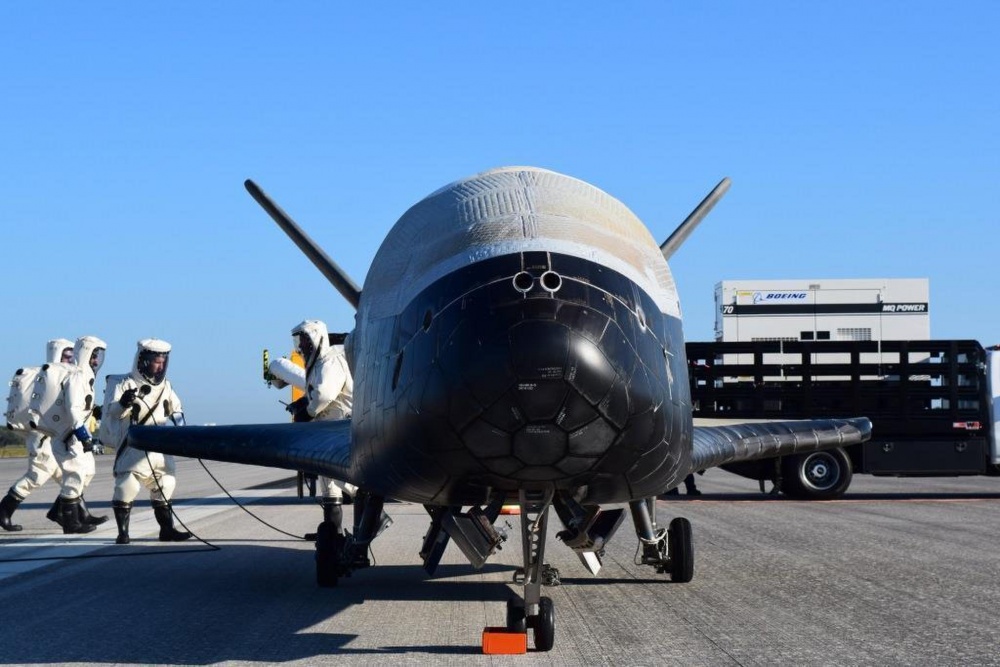
Photos and video: USAF
Specifically, the USAF is operating the X-37 unmanned reusable space plane, and it just completed 2 years in orbit, which is kind of a long time for a technology demonstrator:
Top-secret military spaceplanes certainly know how to make an entrance.

The U.S. military’s X-37B, an uncrewed spacecraft that looks like a miniature version of the retired space shuttles, returned to Earth over the weekend after spending nearly two years in low-Earth orbit. It sent shockwaves rippling through the air as it entered the atmosphere over Florida, producing a sonic boom loud enough to jolt people awake across the state. The Air Force, which operates the X-37B, tweeted about its return minutes later, and soon posted a flurry of images and videos of the spaceplane online. “Our team has been preparing for this event for several years, and I am extremely proud to see our hard work and dedication culminate in today’s safe and successful landing of the X-37B,” said Brigadier General Wayne Monteith, the commander of the Air Force’s Space Wing.

To which many observers said, wait, what?

The news that the military had a space shuttle quietly orbiting Earth for more than 700 days came as a surprise to some. Why didn’t we know about this thing, the reaction seemed to go. The reaction illustrated the distinct line between the country’s civilian and military activities in space, and how much the general public knows about each. People know plenty about the civilian side—the missions to other planets, the SpaceX launches, astronauts’ cool Instagram pictures from the space station. But secret military spaceplanes? You usually need a sonic boom to hear about that.
What the hell was was this doing up there so long?

It would be simpler and cheaper to do performance testing on propulsion in a small non-returnable package.

The only thing that I can think it would be doing would be deploying and retrieving some sort of payload, but there should be no need for that:  Any surveillance data would be transmitted digitally these days, and if you were testing something like orbital targeting, it would be simpler, and less easily observed, if you simply deorbited the payload at the end of the test.

The only thing that would explain the duration of the mission is some sort of biological payload, but that would be something that NASA, and not the Air Force, should be doing.

Curiouser and curiouser.

Tuesday, May 9, 2017

Well, This Is a Fine F%$# You to Erdoğan

The US has decidedly to supply arms directly to Kurdish fighters in Syria:

President Trump has approved a plan to directly arm Kurdish forces fighting in Syria, the Pentagon said on Tuesday, inflaming already strained ties with Turkey and putting the U.S. military a step closer to seizing a remaining Islamic State stronghold.

Pentagon spokeswoman Dana W. White said the president made the decision Monday, describing the Syrian Democratic Forces (SDF), a diverse group dominated by Kurdish fighters, as “the only force on the ground that can successfully seize Raqqa in the near future.” For more than a year, the U.S. military has been advancing plans to capture Raqqa, the Syrian city that is the Islamic State’s de facto capital, as the final major step in its nearly three-year effort to defeat the militant group.

“We are keenly aware of the security concerns of our coalition partner Turkey,” White said in a statement. “We want to reassure the people and government of Turkey that the U.S. is committed to preventing additional security risks and protecting our NATO ally.”

………

Ankara sees the YPG as an extension of the banned Kurdistan Workers’ Party, or PKK, which is considered a terrorist group by both Turkey and the United States.
Since Turkey is perhaps the 2nd worst external actor in Syria, after the House of Saud, so the fact that their agenda is going pear shaped is a good thing.

It's fairly clear that Erdoğan is using the conflict with ISIS to reinforce his authoritarian rule, and it appears highly likely that he is intent on creating some sort of Turkish zone of influence akin to the Ottoman empire.

That reality is disabusing Erdoğan of his delusions is a good thing.