.

ad test

Showing posts with label Aviation. Show all posts

Saturday, October 28, 2017

And the Mistake Jet Cluster F%$# Continues

The F-35 was intended to be a major technical leap, not just in performance (it isn't), and not just in stealth (it isn't), but also in terms of its availability and maintenance overhead.

It turns put that it has failed the last bit as well:
The Pentagon is accelerating production of Lockheed Martin Corp.’s F-35 jet even though the planes already delivered are facing “significantly longer repair times” than planned because maintenance facilities are six years behind schedule, according to a draft audit.

The time to repair a part has averaged 172 days -- “twice the program’s objective” -- the Government Accountability Office, Congress’s watchdog agency, found. The shortages are “degrading readiness” because the fighter jets “were unable to fly about 22 percent of the time” from January through August for lack of needed parts.

The Pentagon has said soaring costs to develop and produce the F-35, the costliest U.S. weapons system, have been brought under control, with the price tag now projected at $406.5 billion. But the GAO report raises new doubts about the official estimate that maintaining and operating them will cost an additional $1.12 trillion over their 60-year lifetime.

Already, the agency said in the draft obtained by Bloomberg News, the Defense Department “must stretch its resources to meet the needs of continued system development and production while at the same time sustain the more than 250 aircraft it has already fielded.”
In addition to this, it has been revealed that the first 108 F-35s produced will never be combat capable, so something around $40 billion has been flushed down the toilet:
The new F-35 program executive officer, U.S. Navy vice admiral Mat Winter, said his office is exploring the option of leaving 108 aircraft in their current state because the funds to upgrade them to the fully combat-capable configuration would threaten the Air Force’s plans to ramp up production in the coming years.

These are most likely the same 108 aircraft the Air Force reportedly needed to upgrade earlier in 2017. Without being retrofitted, these aircraft would become “concurrency orphans” — airplanes left behind in the acquisition cycle after the services purchased them in haste before finishing the development process.

Left unsaid so far is what will become of the 81 F-35s purchased by the Marine Corps and Navy during that same period. If they are left in their current state, nearly 200 F-35s might permanently remain unready for combat because the Pentagon would rather buy new aircraft than upgrade the ones the American people have already paid for.

 What makes this particularly galling is the aircraft that would be left behind by such a scheme were the most expensive F-35s purchased so far. When the tab for all the aircraft purchased in an immature state is added up, the total comes to nearly $40 billion.
If you run the numbers, that is about $370 million for each of these hangar queens.

Imagine what could have done with that money.

Monday, October 23, 2017

This Dick Waving Is Going to Get Us All Killed

We now have reports that, for the first time since 1991, the United States Air Force will be putting nuclear bombers back on round-the clock nuclear alert:

The U.S. Air Force is preparing to put nuclear-armed bombers back on 24-hour ready alert, a status not seen since the Cold War ended in 1991.

That means the long-dormant concrete pads at the ends of this base’s 11,000-foot runway — dubbed the “Christmas tree” for their angular markings — could once again find several B-52s parked on them, laden with nuclear weapons and set to take off at a moment’s notice. 

“This is yet one more step in ensuring that we’re prepared,” Gen. David Goldfein, Air Force chief of staff, said in an interview during his six-day tour of Barksdale and other U.S. Air Force bases that support the nuclear mission. “I look at it more as not planning for any specific event, but more for the reality of the global situation we find ourselves in and how we ensure we’re prepared going forward.”
I am NOT feeling any safer right now.

Saturday, October 14, 2017

Israel Has 2Nd Thoughts about V-22 Acquisition


V-22s Range Advantage has a Cost
Israel seemed poised to purchase the tilt-rotor V-22 Osprey, and now they have put this on hold.

I am not particularly surprised.

The V-22 is a maintenance hog, and cost a fair amount to operate.

While the Osprey is about 100 kts faster, has a longer range, it can only carry about 1/3 of the payload, even though it has 2/3 of the installed power.

Additionally, unlike a conventional helicopter, the V-22 does not have a meaningful auto-rotation capability, and its performance with external loads is pathetic.

Israel simply does not have the need for the additional capabilities offered by the tilt-rotor:
The Israeli air force has frozen its evaluation of the Bell Boeing V-22 Osprey, with a senior defence source indicating that the tiltrotor is unable to perform some missions currently conducted using its Sikorsky CH-53 transport helicopters.

In January 2014, the US Department of Defense notified Congress about its intention to sell six V-22s to Israel. This followed an evaluation conducted by air force personnel, which led to the service seeking a rapid acquisition to support special operations. The proposed purchase met with opposition from elsewhere within Israel's defence ministry, however.

Other potential candidates to replace the Israeli air force's aged CH-53s by around 2025 include Sikorsky's new CH-53K and the Boeing CH-47 Chinook.
Simply put, the IDF does not have the requirements, such as amphibious landings from extreme distance, that have driven the V-22, and as such, it does not make sense.

Sunday, October 1, 2017

Another Step Forward for Reaction Engines


Proposed Test Stand


Heat exchanger with miles of tiny tubes
Reaction engines, whose SSTO Skylon concept has been making the rounds for nearly a decade, seems to be getting more support, specifically, it has scored a large contract with DARPA to demonstrate its precooler engine technology:
Reaction Engines has achieved a major breakthrough in the U.S. market with a contract from the U.S. Defense Advanced Research Projects Agency (DARPA). The award covers conducting high-temperature testing of the precooler technology at the heart of its proposed hypersonic air-breathing, combined-cycle Sabre rocket concept.

Reaction has seen interest grow in the U.S. about elements of Sabre, particularly the precooling heat exchanger, ever since the concept was first independently validated by the U.S. Air Force Research Laboratory in 2015 (AW&ST Aug. 3-16, 2015, p. 63). Designed to chill airflow from over 1,800F to −240 F (1,000C to −150C) in less than 1/20th of a second, the heat exchanger is pivotal to the process of extracting oxygen from the air for use by the rocket.

However, the heat exchanger can also be used more generically to precool other engine cycles and reduce heating on engine components in high-speed flight. According to Reaction, the design, dubbed HTX, “could enable new classes of vehicles and operational possibilities.” The precooler will be tested at speeds up to Mach 5 in a new high-temperature airflow evaluation facility to be built in Castle Rock, Colorado, as a base for REI (Reaction Engines Inc.), the U.S. subsidiary of the UK-based company.
It does appear that their technology is getting funding and support, so I'm hoping to see a flight test article in the next 5 years or so.

Previous posts about Reaction Engines here.

Bad Day at the Office

There was an uncontained engine failure on Airbus A380 on a Paris to London flight:

An Air France A380 superjumbo jetliner taking more than 500 people from Paris to Los Angeles made an emergency landing in Canada on Saturday following “serious damage” to one of its four engines, the airline said.

“Flight 066 landed without further damage at the Goose Bay military airport in Canada and all of the 520 people on board were evacuated with no injuries,” an Air France spokesman in Paris said.

The Airbus double-decker, wide body aircraft was rerouted as it passed over Greenland, landing in Goose Bay in eastern Canada, the spokesman said.

The landing went off with no problems for the jetliner carrying 496 passengers and 24 crew members, the spokesman said. The airline was exploring options to get the passengers to the US.
Glad not to be on that flight.

Monday, September 11, 2017

Same as it Ever Was ……… Same as it Ever Was ……… Same as it Ever Was ……… Same as it Ever Was ……… Same as it Ever Was ………

When Boeing rolled out is 777, it decided that the best way to maximize profits was to recruit potential competitors to be risk sharing partners to minimize its upfront costs.

The net result was significant delays and a loss of technical know-how, and now, both Boeing and Airbus are looking to bring these capabilities, because it turns out that they outsourced their profits as well:

The world’s largest plane makers are testing a seemingly simple formula to smooth production, cut costs and fatten profits: Make more of the parts that go into their jets themselves.

In the wake of United Technologies Corp.’s proposed $23 billion deal to buy Rockwell Collins Inc., that push is taking on more urgency. The deal is the latest in a round of consolidation among the world’s biggest suppliers of aviation parts—something Boeing Co. and European rival Airbus SE have eyed warily.

Earlier this week, Boeing said it might cancel some of its parts contracts if the deal undermines competition further in the aerospace supply chain. Airbus had previously expressed its skepticism over it.


Worried about getting squeezed by the consolidation, Boeing and Airbus have moved to protect themselves by building more of their parts in-house. This month, Boeing will start construction of a new production facility in Sheffield, England, that will make some of its own actuation equipment—motors that help move a wing’s flaps. Airbus, meanwhile, is planning to build some of its own nacelles, the metal casings that house a plane’s engines. United Technologies is one of the world’s largest nacelle suppliers.

………


Boeing decided two years ago to make some of its own nacelles after years of buying them. In July, the company also said it is planning to develop and build some aircraft electronics, a market dominated by companies such as Rockwell Collins and Honeywell International Inc.

The wings for a revamped version of Boeing’s new 777 jetliner also will be built at a new plant near Seattle rather bought from a supplier. Boeing bought the wings from a supplier for its last big project, the 787 Dreamliner.


………


Bringing production in-house helps level the playing field.

Those parts makers have also traditionally been able to suck out more profit for their components than plane makers like Boeing and Airbus can extract for selling whole aircraft. Profit margins for plane and engine makers have averaged 9% over the past two years, compared with 14% for so-called “tier one” suppliers such as United Technologies and Rockwell Collins, which make finished parts directly for plane makers. Margins come in at 17% for tier 2 suppliers, which provide smaller components for those parts, according to Boston Consulting Group.
This is not a surprise.

The idea that drove the outsourcing of critical technologies for the 787 was that Boeing could be more profitable and efficient by doing and knowing as little as is possible about the underlying business.

This is classic MBA/High Finance type thinking, and MBA/High Finance type thinking unmoored from the underlying business has ALWAYS been a recipe for dismal failure.

Wednesday, August 16, 2017

TASS: Military & Defense - Russia’s 5th-generation fighter jet named as Su-57


Roll promotional video with cheesy music
The Sukhoi fighter jet, has had its name updated from T-50 (Basically the company's internal designation meaning the 50th delta wing model) to the official Russian military designation Su-57. (Also here)

I don't think that this means a whole bunch in the greater scheme of things, but have a promotional video for the 5th generation fighter.

It doesn't reflect much in the way of a change in the status of the aircraft:  It's still a limited production prototype, and the intended final engine is years down the road, but it does make for some decent videos.

Wednesday, August 9, 2017

This Makes the F-35 Program Look Well Run

I am referring, of course, to India's history with developing indigenous weapons systems.

For example, we have the now-terminated and protracted development of the Arjun tank and the INSAS rifle system, but Tejas program, has suffered through a 33+ year development program is crown jewel of this dubious crown.

And now we see more schedule slippage:

The Indian Ministry of Defence (MoD) has revealed further delays in the country’s programme to produce the Tejas Light Combat Aircraft (LCA) for the Indian Air Force (IAF).

The MoD said in a statement on 4 August that state-owned Hindustan Aeronautics Limited (HAL) has delivered just four aircraft to the IAF out of 40 ordered in 2005. All these aircraft were previously scheduled to be delivered to the IAF by 2017–18.

The four aircraft so far delivered are from a batch of 20 designated for initial operational clearance (IOC), while the remaining 20 aircraft were designated for final operational clearance (FOC).

The MoD said that 12 remaining aircraft under the IOC batch are at the production stage and four more aircraft, which will be used as trainers, will be produced following necessary approvals by the MoD’s Aeronautical Development Agency (ADA).

It added that production of the 20 FOC aircraft will also depend on clearance by the ADA, which has led the Tejas development programme for the past three decades.
This is f%$#ed up and sh%$.

Monday, July 24, 2017

United Strikes Again

United notified passengers that they could not check check comic books in as luggage if they were flying to Comic Con in San Diego, because ……… Transportation Security Administration (TSA).

The TSA released a statement that United Airlines had f%$#ed up: (Also here)

Don’t worry Comic-Con fans, you don’t have to remove your comic books from your checked luggage, despite what a Sunday photo circulated on Twitter suggests.

The dust-up began after a person named Adi Chappo tweeted the above, tagging United Airlines, which responded on Twitter:


But by Monday, the Transportation Security Administration was saying that no such restriction existed.


Lorie Dankers, a TSA spokeswoman, told Ars on Monday morning that she was mystified as to how United could get this policy wrong. “I don’t know how United went ahead and stated a TSA policy incorrectly,” she said. “I can say that TSA has advised in the past that if people bring several of the same type of item, it can alarm the checked baggage screening, but there is no prohibition on bringing things that are not a security threat. In this case, comic books are not a security threat and we encourage travelers to bring them if they so choose.”
Seriously, they make big bank on checked bags, so it takes a special type of incompetence to do this.

They are both inconveniencing the customer and losing money on the deal.

Friday, July 21, 2017

Dayyyymmmmnnnnn!

I just came across these videos of the Su-35 putting on an amazing display at the MAKS airshow:


Here is a shorter vid:


I'm not gonna claim that this is a demonstration of meaningful real world combat capabilities, but this is jaw dropping.

Thursday, July 20, 2017

Epic Troll

Over at The Register, they discuss how the Royal Navy will maintain offensive capability now that they will have no antiship weapons between 2018 and 2020.

Their proposal is to put the biplane Fairey Swordfish torpedo bomber on their aircraft carriers:
The solution to the Royal Navy’s post-2018 problem of having no anti-ship weapons is already in service and can even equip the UK’s new aircraft carriers.

The Fairey Swordfish (pictured above) is a versatile, rugged torpedo bomber first introduced into service in the 1930s. Having outlived everything introduced to replace it during the WWII, two flying examples remain in service with the RN Historic Flight.

These two aircraft could each be assigned to HMS Queen Elizabeth and HMS Prince of Wales, the 70,000-ton aircraft carriers due to enter naval service in the near future.

Although neither carrier has catapults (or, indeed, aircraft until the year 2021), the Swordfish is capable of taking off within 540ft at full power* with the ship steaming into a 20kt wind – which compares very favourably with the QE-class’s 920ft flight deck.

The Swordfish has a noble and proud history of delivering the Navy’s ship-sinking capability, most notably over the Italian fleet at Taranto in 1940 and crippling the battleship Bismarck later in WWII. It is a proven war-winning platform with a straightforward wood-and-canvas construction that means spares and logistic trains will cost infinitely less than the heart-stoppingly expensive F-35B fighter jet (at around $130m per aircraft, according to some estimates) which will not be able to fly from the British carriers until 2021 at the earliest.
Snerk!

Sunday, July 16, 2017

The Problem Was the Original Purchase

Austria will be removing the Eurofighter Typhoon from service ahead of schedule because they have found it too expensive to operate:

It is a matter of concern for an aircraft manufacturer when one of the richest countries in the world declares its fighter is too expensive to operate.

But then Austria is a something of a special case. Critics generally agree that the landlocked neutral state probably never really needed the 15 Eurofighter Typhoons it ordered in 2003.

In Austrian hands, the advanced multirole fighter, originally designed to tackle the latest Russian threats, has been relegated to an interceptor role, with many of its advanced electronic warfare systems removed.
I don't get why they bought the aircraft in the first place.  It's not like Slovenia is going to invade them any time soon.

My suggestion would be to replace it with an inexpensive subsonic aircraft, something like the BAE Hawk, but if they feel compelled to go with a supersonic aircraft to deal with the threat from Switzerland or Italy, I would suggest the Chinese/Pakistani JF-16, which is less than half the purchase price of western aircraft.

But even in this case, to quote Eisenhower, "Every gun that is made, every warship launched, every rocket fired signifies, in the final sense, a theft from those who hunger and are not fed, those who are cold and are not clothed."

Tuesday, July 4, 2017

If You Can't Beat Them, Join Them


Reverse flow operation (starts at 45s)


See also this diagram


The GE Engine
GE will be attempting to challenge Pratt & Whitney in the turboprop market, where the PT6 turboprop completely dominates the market.

Of interest to me is that GE will be copying the basic operating principals of the PT6,(paid subscription required) P&W's reverse flow operation.

The inlet is at the back of the engine, and air flows forward. This allows the compressor and the compressor turbine to be completely separate from the power turbine and prop.

While the air flow is rather more circuitous than that of a straight through engine, it has a number of significant advantages:
  • No need for concentric shafts while still maintaining a two spool compressor and turbine.
  • A smaller and lighter starter motor.
  • More easily adopted to different power levels.
  • Greater simplicity and reliability.
The PT6 has used this formula to completely dominate the market, and it looks like GE will be aping their approach, with a lot of additive manufacturing throw into the mix:
………

Then there’s the ATP, GE’s Advanced Turboprop engine (see photo, above). This is a very big deal in terms of technology and targeting.


For those cloistered monks among you, some background: Pratt & Whitney Canada’s PT6 family has reigned supreme among turboprops since, well, forever. And for good reason. The type ranges in power from 500-2,000 shp and has demonstrated rock-solid reliability through decades of operation. Its bulletproof reputation is the reason almost all single-turboprop-powered aircraft—from the Piper’s owner-flown M600 to Beechcraft’s PT-6 Texan II military trainer to the do-it-all Pilatus PC-12—are fitted with a PT-6. More than 51,000 PT6s have been produced since the engine’s introduction in the 1960s. It has been expanded to include 69 versions that power some 100 different aircraft models, including all production King Airs.

GE hopes the ATP will break Pratt’s near monopoly. Developed at the company’s “turboprop center of excellence” in Prague with a $400 million investment, this, the world’s most “printed” engine (additive manufacturing has replaced 855 parts with a mere dozen 3D-printed components)features a single-lever integrated engine and propeller control, 16:1 pressure ratio, reverse-flow combustor and output of 850-1,650 shp. The design promises 20% better fuel burn, 10% more power and longer maintenance intervals than you know what.
This is, in its own way, a tribute to the genius of the design team that first devised the PT6.

Tuesday, June 27, 2017

And for the next Trick, United Airlines Will Boil a Baby

I wish that I was joking:

While aboard a grounded flight destined for Texas, a Colorado mother said she thought her son was going to die in her arms as temperatures in the cabin spiked.

Emily France’s 4-month-old son Owen had to be hospitalized after overheating on a United flight waiting to depart Denver International Airport.

France and Owen boarded United Airlines flight 4644 around 1:20 p.m. on Thursday, expecting to take off thirty minutes later.

While sitting in her assigned seat at the rear of the plane, France said the cabin was already noticeably hot. 

After the flight was delayed due to re-fueling and a reroute caused by bad weather, France told the Post she tried to cool her son using wet wipes. Eventually flight attendants brought France and another mother ice to press against their children’s bodies.

France was allowed to exit the aircraft for approximately 20 minutes, according to the Post, but was then asked to return for takeoff. Once back on board, the plane pushed away from the gate, but with temperatures still sweltering, things continued to worsen.

“His whole body flashed red and his eyes rolled back in his head and he was screaming,” France told the paper. “And then he went limp in my arms. It was the worst moment of my life.”

France told the Post that she and other passengers begged to return to the gate, but ground and air crews seemed to be debating how to best handle the situation.

“This should never have happened,” United Airlines said in a statement to NBC News. “We are profoundly sorry to our customer and her child for the experience they endured. We are actively looking into what happened to prevent this from occurring again.”
They could have let people off the plane while they were waiting.

They could have turned on the APU to supply some cooling.

If the APU was not working, they could have cooled off the plane with a start cart.

They did none of these things, because  ……… United Airlines.

"Friendly Skies," is grammatically correct irony.

Friday, June 16, 2017

Gripen E Makes Maiden Flight

The upgraded Gripen, which is basically a completely new aircraft, jas just made its first flight:

Swedish aerospace and defense company Saab has completed the first flight of its prototype E-model Gripen fighter jet.

The prototype, coded 39-8, took to the air at 10:32 a.m. local time June 15 from the company’s development facility at Linkoping, flying for 40 min. and reaching an altitude of 13,000 ft. before touching down safely.

Video and imagery of the aircraft departing and inflight showed a relatively short takeoff run in dry power and revealed that the company retracted the landing gear inflight, a relatively rare occurrence in first flights. Two twin-seat JAS-39D Gripens acted as chase aircraft.
The aircraft took 10 years to develop, which by the standard of modern fighter development is a very short time, and while pricier than its it is still far cheaper to operate than its competitors.

Total employment on the program is less than that of just the program office for the F-35, and total development cost for the program was less than that of the most recent software release for the JSF. (link)

There is no reasonable justification for the protracted and expensive developments that have become the standard in western fighter programs.

Here is a PR video from Saab:

Thursday, June 8, 2017

Oh, Those Backward Russians………

The Russian MS-21 narrow body airliner is first use of non-autoclaved composites in the primary structure of a commercial aircraft:

As Russian aircraft manufacturer Irkut Corp. (Irkutsk, Russia) rolled out its narrow-body MS-21 (132-211 passengers) today (June 8), it’s time to recognize again the novelty of this plane. The MS-21 will carry into the air a major aerospace and composites industry milestone: The first out-of-autoclave (OOA) composite wing and wing box on a commercial aircraft.

As CW reported in early 2014, the MS-21 wing and wing box represent a major and hard-won accomplishment in aerospace composites manufacturing. Never before has such a large, complex and important aerostructure been made OOA. So, it’s worth reviewing now how it was made.

The OOA parts— the wing box, integrated stringers and skins, and spars — are fabricated by AeroComposit (Moscow, Russia), a sister company of Irkut (both are owned by Moscow-based United Aircraft Corp.). The materials used come from Solvay (Cytec when plane development was begun; Woodland Park, NJ, US). The layup is done via placement of unidirectional dry fiber with automated tape laying (ATL) equipment provided by MTorres (Torres de Elorz, Navarra, Spain) and Coriolis (Queven, France).

Lance Parcell, new business development director at Solvay, provided development assistance to AeroComposit starting in 2008 and says the material used, EP 2400, is “a unique product that is toughened and infusible without having to introduce tougheners in other forms like films or polymer fibers.” Further, the resin offers a long window for the infusion process, which provides more than adequate time for large primary structures such as wings. The result, says Parcell, is very low porosity in the final part that “is equal to or less than in an autoclave.”
In a conventional aviation composites, an autoclave, which applies both heat and pressure.

The pressure is used to push the resin in between the fibers to prevent voids.

An autoclave is both an oven and a pressure vessel, and at larger sizes they are expensive and finicky items.

Another option is to make smaller pieces and fasten them together, but that creates a whole new set of issues 

If you can infuse the resin without voids, then you can just cure the resin in an ordinary oven, which is cheaper and easier.

This has been done in marine composites for years, but in those applications, you are not trying to use an absolute minimum of material.

In the weight conscious aviation field, adding margin is not an option.

It's a pretty impressive technical feat.

Sunday, May 21, 2017

Well, They Would Say That, Wouldn't They?*

Boeing is suggesting that the US Navy would be better served by evolving the existing F/A-18 rather than spending two decades to develop another hyper-expensive stealth fighter. (paid subscription required)

Boeing is making a statement in own interest. It sells the F-18.

Boeing also happens to be right in this case: Development programs that are egregiously expensive and span decades do not produce weapons that work properly.

Either they perform poorly, or they are too expensive to deploy in the numbers in which they would be needed:

Boeing has cautioned the U.S. Navy against getting locked into another 20-year aircraft development program as it reaches for the F/A-XX, the service’s next carrier warplane.


The company says continuing to evolve the F/A-18E/F Super Hornet through Block 3 beginning in fiscal 2019 and a potential Block 4 follow-on modernization program as a complement to the Lockheed Martin F-35C Lightning II is the most prudent path forward to satisfy an immediate need for greater numbers of strike fighters with advanced capabilities.


Boeing says low-radar-cross-section airframes are useful for the first day of war and flying into denied areas guarded by X-band radars. But the integrated air defense radars of potential adversaries such as Russia and China have moved into different bands of the electromagnetic spectrum, such as C-band and S-band. Buying into a next-generation stealth aircraft development program under F/A-XX might not be the best answer to meet current and future threats, Boeing believes.


………


“For the Navy, and I think for a lot of countries, don’t lock yourself into a 20-year development cycle and a platform you’re stuck with for X amount of years,” says Larry Burt, a former naval aviator and now Boeing’s director of global sales and marketing for global strike programs. “Don’t make a big revolutionary step. Keep evolving what you’ve got. You could keep evolving the mission systems, sensors and capability of the Super Hornet and maybe eventually put a new wrapper on it.”
With the 2nd most protracted and dysfunctional weapons development program in the world (India's is worse), they are right.

US defense procurement is a racket, with the contractors spreading sub-contractors to the districts of powerful Congressmen, and providing lucrative sinecures to the generals involved in their retirement.

*Yes, this is a reference to Mandy Rice-Davies.

Saturday, May 13, 2017

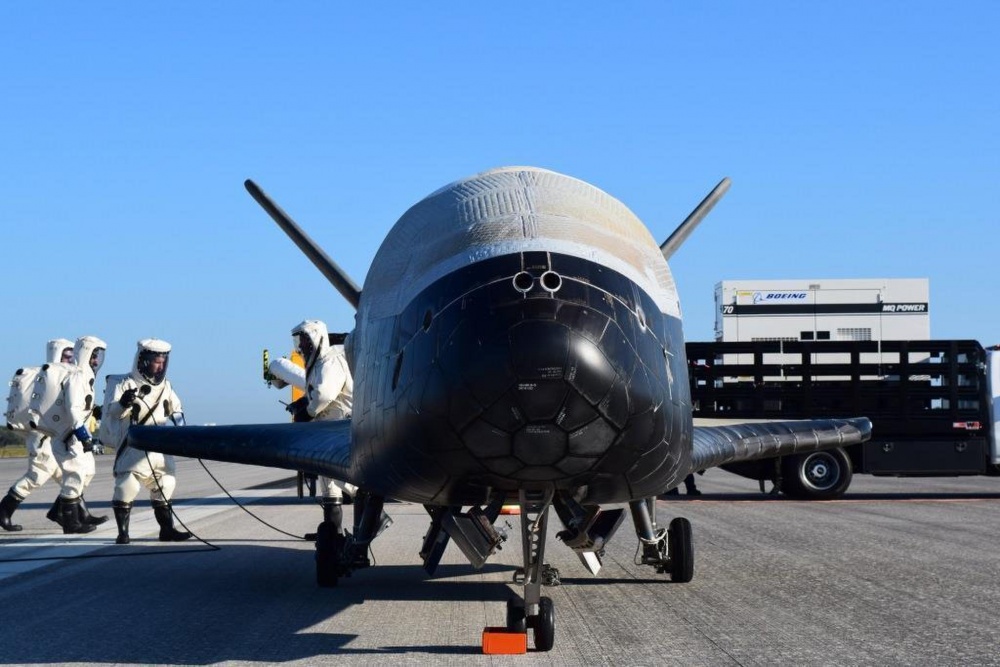
Well, This is a Bit of a Riddle


Photos and video: USAF
Specifically, the USAF is operating the X-37 unmanned reusable space plane, and it just completed 2 years in orbit, which is kind of a long time for a technology demonstrator:
Top-secret military spaceplanes certainly know how to make an entrance.

The U.S. military’s X-37B, an uncrewed spacecraft that looks like a miniature version of the retired space shuttles, returned to Earth over the weekend after spending nearly two years in low-Earth orbit. It sent shockwaves rippling through the air as it entered the atmosphere over Florida, producing a sonic boom loud enough to jolt people awake across the state. The Air Force, which operates the X-37B, tweeted about its return minutes later, and soon posted a flurry of images and videos of the spaceplane online. “Our team has been preparing for this event for several years, and I am extremely proud to see our hard work and dedication culminate in today’s safe and successful landing of the X-37B,” said Brigadier General Wayne Monteith, the commander of the Air Force’s Space Wing.

To which many observers said, wait, what?

The news that the military had a space shuttle quietly orbiting Earth for more than 700 days came as a surprise to some. Why didn’t we know about this thing, the reaction seemed to go. The reaction illustrated the distinct line between the country’s civilian and military activities in space, and how much the general public knows about each. People know plenty about the civilian side—the missions to other planets, the SpaceX launches, astronauts’ cool Instagram pictures from the space station. But secret military spaceplanes? You usually need a sonic boom to hear about that.
What the hell was was this doing up there so long?

It would be simpler and cheaper to do performance testing on propulsion in a small non-returnable package.

The only thing that I can think it would be doing would be deploying and retrieving some sort of payload, but there should be no need for that:  Any surveillance data would be transmitted digitally these days, and if you were testing something like orbital targeting, it would be simpler, and less easily observed, if you simply deorbited the payload at the end of the test.

The only thing that would explain the duration of the mission is some sort of biological payload, but that would be something that NASA, and not the Air Force, should be doing.

Curiouser and curiouser.

Sunday, April 30, 2017

The Little Fighter that Could

Bulgaria has selected the Gripen to replace its MiG-29's:

Bulgaria has selected the Saab Gripen as its new future fighter aircraft, the country's interim deputy prime minister reportedly announced on 26 April.

Stefan Yanev said talks will now take place with Sweden to acquire eight aircraft to replace its Warsaw Pact-era MiG-29 'Fulcrum' fighters, the Reuters news agency reported, adding that a special commission into the procurement will be set up within a week.

………

While not specified in the Reuters report, Saab had offered Bulgaria the C/D-variant of the Gripen, and had offered to restart the production line which had recently transitioned over the E model (some Gripen C/D work has continued as Saab prepares for an expected Slovakia contract) .

In apparently securing selection, the Gripen beat-off competition from the Lockheed Martin F-16 Fighting Falcon, which Portugal was offering second-hand, and from the Eurofighter Typhoon, surplus models of which were being offered by Italy.
I gotta think that the lower direct operating cost, on the order of ½ that of the Typhoon, and about ⅓ less than the F-16, had a lot to do with this decision.

I also think that there may have been a preference for new, rather than 2nd hand fighters for all the wrong reasons.(i.e. national pride).

Friday, April 28, 2017

Have Some Helicopter Pr0n

I present to you the Sikorsky S-97 Raider:


I favor this over a tilt-rotor.

I want my rotor craft to auto-rotate in the event of an engine failure.