.

ad test

Showing posts with label Saroff's Rule. Show all posts

Thursday, August 11, 2016

The General Case of Saroff's Rule

Let me remind you of what I call  Saroff's Rule, "If a financial transaction is complex enough to require that a news organization use a cartoon to explain it, its purpose is to deceive."

Well, a recent paper by economists from MIT, ASU, and UCSD shows that complexity more generally appears to have deception as its primary purpose:
Economist George Akerlof has spent much of his celebrated career thinking about how trickery and deceit affect markets. His most famous insight, which won him the 2001 Nobel Prize in economics, is that when buyers and sellers have different information, lack of trust can cause markets to break down. In those models, no one actually ends up getting tricked -- everyone is perfectly rational, so even the possibility of getting cheated causes them to stay prudently out of the market. But in his book “Phishing for Phools,” written with fellow Nobelist Robert Shiller, Akerlof goes one step further. Much of the actual, real-world economy, he says, involves trickery and deception.

………

A recent paper by economists Andra Ghent, Walter Torous and Rossen Valkanov may shed some light on the question. Ghent and her co-authors look at mortgage-backed securities, which figured prominently in the crisis. They try to measure how complex various products were, using measures like the number of pages in the prospectus, the number of tranches in the security and the number of different types of collateral.

That allowed the researchers to see whether more complex products fared better or worse in the years before the crisis. Using Bloomberg data, they look at private-label, mortgage-backed securities issued between 1999 and 2007. They then look forward in time, to see which products defaulted and which ones experienced more foreclosures in the mortgage pools that they used as collateral.

It turns out that complexity was a bad sign. More complex deals experienced higher default rates and more foreclosures on their collateral. So if you were an MBS buyer from 1999 to 2007, the rational thing to do would have been to demand a higher interest rate on a more complex security.

Except that didn’t happen. Ghent et al. found that complexity had no correlation with the yields on MBS. That means that although more complex products were riskier on average, buyers didn’t recognize that fact. The authors also carefully exclude the possibility that complex deals commanded higher prices because they were specially tailored to individual buyers’ needs -- in fact, most products contained the same types of collateral, but the complex ones were just of lower quality.

………

Interestingly, Ghent and her coauthors find that credit-ratings companies tended to give higher grades to more complex products. That implied the credit raters were willing to trust issuers when figuring out what was actually in the products got too hard. Maybe it’s human nature to trust our counterparties more when things get too complicated. Or maybe the ratings companies’ well-known bad incentives took over when complexity and opacity made their misbehavior harder to observe.
I will go a step further than the economists do (45 page PDF), the words "fraud" "corruption" and "crime do not occur in the paper, and suggest that this complexity is present because of a deliberate and specific intent to deceive investors, and that the credit rating agencies were willfully blind to this because it made the money.

To paraphrase Paul Volker, no useful innovations have come from banks since the introduction of the automatic teller machine.

Reinstate the principle you can only buy insurance on things when you have a direct interest in their continued existence.

It's a principle that was made law by the Marine Insurance Act of 1746, and worked until people decided that things like naked credit default swaps were an essential innovation.

Reinstate that.

Put derivatives at the back of the bankruptcy queue, not the front.

Put a Tobin tax on financial transactions.

Shut it down.

Shut it all down.

Monday, March 18, 2013

I Have a New Rule for Finance and Fraud

The first was coined by Eric Falkenstein:

People who meticulously avoid email should not be trusted, because it is simply too calculating, as if they know they are regularly committing crimes. A phone conversation can always be disavowed, you just say you were talking about last weekend's bar mitzvah.
The 2nd rule, which I call Saroff's Rule:
If a financial transaction is complex enough to require that a news organization use a cartoon to explain it, its purpose is to deceive.
Well, now I have another rule, if your business plan requires an extraterritorial location not subject to any national law, it is because the principals involved intend to be lawless:
A company named Blueseed is a year away from offering entrepreneurs an inexpensive place, near Silicon Valley, in which to develop their products.

"Blueseed will station a ship 12 nautical miles from the coast of San Francisco, in international waters. The location will allow startup entrepreneurs from anywhere in the world to start or grow their company near Silicon Valley, without the need for a U.S. work visa. The ship will be converted into a coworking and co-living space, and will have high-speed Internet access and daily transportation to the mainland via ferry boat. So far, over 1000 entrepreneurs from 60+ countries expressed interest in living on the ship."
No Civil Rights Act, no Equal Employment Opportunity Commission, no Fair Labor Standards Act, no Securities Exchange Act, no RICO statute, no consumer protection laws, no laws against slavery or indentured servitude, and indeterminate tax jurisdiction.

If you get an offer from these people, run the other way.

H/t Naked Capitalism.

Wednesday, September 12, 2012

Dodd Frank is Working

Not.

Case in point, the new clearinghouses are allowing for "collateral transformation" which serves to once again misstate counter-party risk to the detriment of society and the markets:

More obviously troubling was a Bloomberg story on how major financial firms are going to undermine the effectiveness of clearinghouses by engaging in “collateral transformation”:
Starting next year, new rules designed to prevent another meltdown will force traders to post U.S. Treasury bonds or other top-rated holdings to guarantee more of their bets. The change takes effect as the $10.8 trillion market for Treasuries is already stretched thin by banks rebuilding balance sheets and investors seeking safety, leaving fewer bonds available to backstop the $648 trillion derivatives market.

The solution: At least seven banks plan to let customers swap lower-rated securities that don’t meet standards in return for a loan of Treasuries or similar holdings that do qualify, a process dubbed “collateral transformation.” That’s raising concerns among investors, bank executives and academics that measures intended to avert risk are hiding it instead.
Understand what is happening here: clearinghouses are one of the major elements of Dodd Frank to reduce counterparty risks. But the banks are proposing to vitiate that via this “collateral transformation” which will simply create new, large volume counterparty exposures to deal with fictive clearinghouse risk reduction program. And get a load of this:
U.S. regulators implementing the rules haven’t said how the collateral demands for derivatives trades will be met. Nor have they run their own analyses of risks that might be created by the banks’ bond-lending programs, people with knowledge of the matter said. Steve Adamske, a spokesman for the U.S. Commodity Futures Trading Commission, and Barbara Hagenbaugh at the Federal Reserve declined to comment
Translation: the regulators are aware of the banks’ plans to finesse the clearinghouse requirements, and they neither intend to put a kebosh on it (which could easily be done by taking the position that any collateral transformation to meet clearinghouse requirements was an integrated part of the clearinghouse posting and could not be done separately on bank balance sheets) nor understand the impact of their flatfootedness.
The problem is that with complexity ("Innovation") does not create benefits as much as it creates opportunities for fraud. (Saroff's rule restated)

The problem is that finance lends itself to the selling of snake oil even more than does the sale of patent medicine, and the excesses of patent medicine, most notably Radithor, led to the requirement that medications be proven safe and effective before being foisted off on the public.

We need the same policy for financial instruments.

Tuesday, June 5, 2012

Saroff's Rule Again

Click for full size


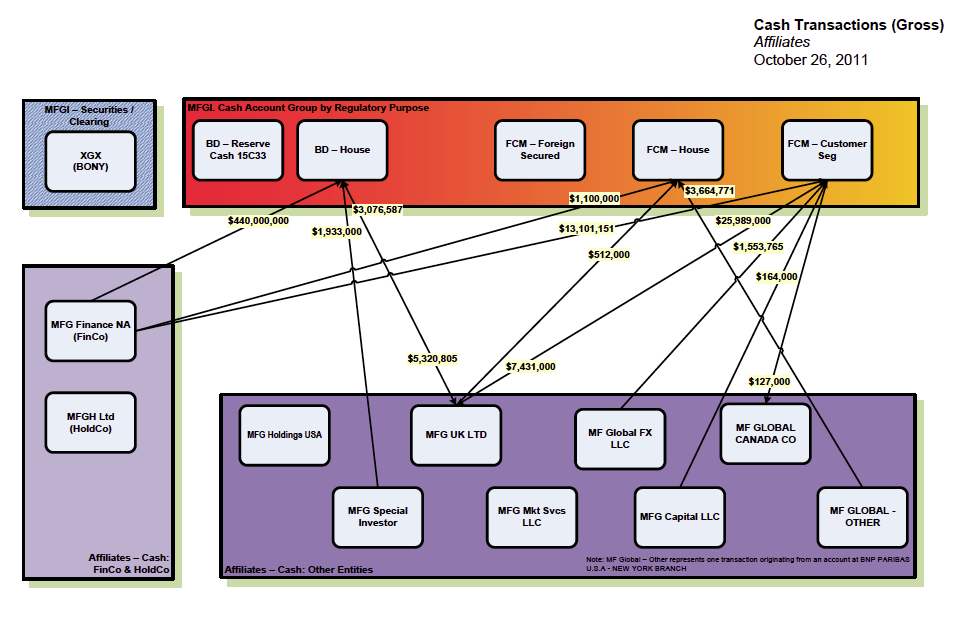
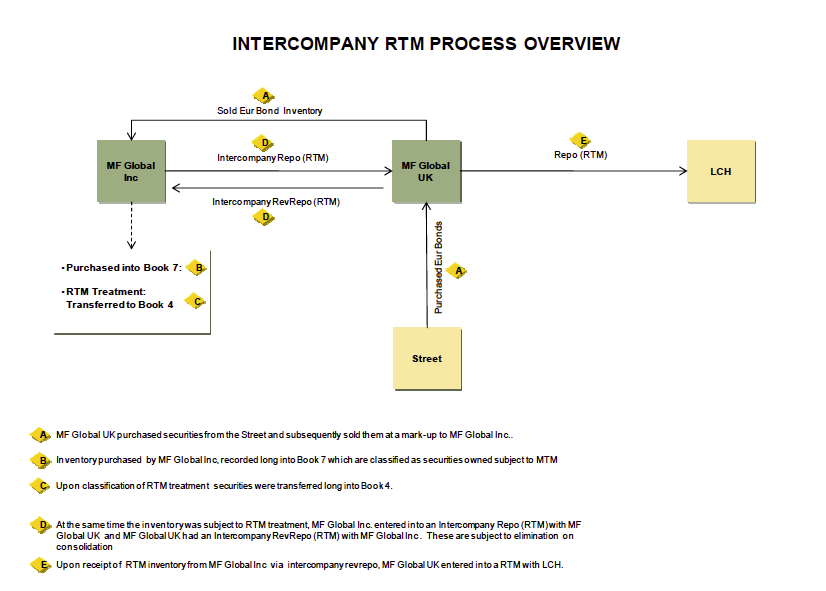
How they shuffled around funds to create the appearance of liquidity


And this is how they covered up their exposure
Yves Smith is all over the report by the bankruptcy trustee for MF Global.

I suggest that you read it, so I will show you to two graphics from the report, and remind you of "Saroff's Rule", "If a financial transaction is complex enough to require that a news organization use a cartoon to explain it, its purpose is to deceive."

It appears that this applies to bankruptcy trustees as well as news orgs.

Go read, and wonder why John Corzine isn't being frog marched out of his mansion in hand cuffs.

Sunday, March 6, 2011

Again, I Invoke Saroff's Rule

Click for full size

Here's a Shocker, MERS is a Fraud
As I have said many times, "If a financial transaction is complex enough to require that a news organization use a cartoon to explain it, its purpose is to deceive."

Well, Michael Powell and Gretchen Morgenson of the New York Times, cover it, and I think that this is the important take away:
Apparently with good reason. Alan M. White, a law professor at the Valparaiso University School of Law in Indiana, last year matched MERS’s ownership records against those in the public domain.

The results were not encouraging. “Fewer than 30 percent of the mortgages had an accurate record in MERS,” Mr. White says. “I kind of assumed that MERS at least kept an accurate list of current ownership. They don’t. MERS is going to make solving the foreclosure problem vastly more expensive.”
(emphasis mine)

Regardless of issues of law, on matters of basic fact MERS is completely unreliable, and the attempts by regulators to protect it are actually an assault on basic property rights, which depend on the rule of law, in the United States.

I'm not suggesting that anyone should go full Tyler Durden at "Library Street, in Reston, VA," but I am suggesting that someone with a law go full avenging angel on their asses, with a good dose of RICO mixed in.

H/t Barry Ritholtz.

Wednesday, November 17, 2010

Speaking of Saroff's Rule

Click for full (honking big) size

If a financial transaction is complex enough to require that a news organization use a cartoon to explain it, its purpose is to deceive.
Williambanzai7 at zero hedge finds this description of how mortgage securitization works from an auditor by the name of Dan Edstrom.

The gentleman, "Performs securitization audits (Reverse Engineering and Failure Analysis) for a company called DTC-Systems."

Of course, Saroff's Rule does not strictly apply here.

This is not the product of a publication that is generating graphics for the edification of the reading public.

This is a visual aid to a Securitization Workshop for Attorneys, and it is what happened to his own mortgage.

This is not some theoretical mortgage that he looked at. This is his mortgage.

It took him a full year to track it all down, and his business is to do mortgage securitizations.

This happens because complexity is the enemy of transparency, and without transparency, the opportunities to profit by cheating and defrauding your counter-parties increases.

Huh, I Never Posted The Definition of "Saroff's Rule"

While I post occasionally about what I call "Saroff's Rule," I realized that I have never posted the definition explicitly, at least not in a post of its own, so here goes:

If a financial transaction is complex enough to require that a news organization use a cartoon to explain it, its purpose is to deceive.
So, there you have it.

Thursday, April 15, 2010

A Corollary to Saroff's Rule


Sex, Lies, and Videotape?
You know Saroff's Rule:
If a financial transaction is complex enough to require that a news organization use a cartoon to explain it, its purpose is to deceive.
Well, now I have to come up with a corollary for puppet shows, because the always entertaining Dylan Ratigan has added this to the mix.

[on edit]If anyone can give me suggestions, it would be appreciated.

It's kind of like School House Rock, on a bad acid trip.

Tuesday, April 13, 2010

Saroff's Rule, Once Again

Click for full size

Saroff's rule: If a financial transaction is complex enough to require that a news organization use a cartoon to explain it, its purpose is to deceive
The New York Times has a description of how Lehman Brothers used a front company to obtain credit and conceal debt:
It was like a hidden passage on Wall Street, a secret channel that enabled billions of dollars to flow through Lehman Brothers.

In the years before its collapse, Lehman used a small company — its “alter ego,” in the words of a former Lehman trader — to shift investments off its books.

The firm, called Hudson Castle, played a crucial, behind-the-scenes role at Lehman, according to an internal Lehman document and interviews with former employees. The relationship raises new questions about the extent to which Lehman obscured its financial condition before it plunged into bankruptcy.

While Hudson Castle appeared to be an independent business, it was deeply entwined with Lehman. For years, its board was controlled by Lehman, which owned a quarter of the firm. It was also stocked with former Lehman employees.

None of this was disclosed by Lehman, however.
Not surprised about their doing this, though I am surprised that this is, at least nominally, legal.

Thursday, November 12, 2009

Uh-Oh, Another Wall Street Journal Cartoon Illustrating Finance


I've said it before, and I'll say it again: When the Wall Street Journal Describes Finance With Cartoons, it Means that Someone will Get Boned, and it ain't the "Bankers, Lawyers, and Other Advisers."
Which means that taxpayers are about to get boned again, without lube.

Once again, regulators have allowed banks to slice and dice loans in order to improve appearances on their bottom line:
In an interview, Joe Exnicios, chief risk officer of Whitney's Whitney National Bank unit, of New Orleans, cited a hypothetical example in which a developer borrows money to develop a small retail center and gets a drugstore chain to sign a lease for one store. If the developer can't sell the other sites, he would be unable to repay the loan. Under the new guidelines, the bank could create a healthy, performing loan supported by the drugstore lease and a nonperforming loan from the rest of the loan. "It may make a difference on whether you need to have additional capital and take additional reserves," he said.
Critics agree that regulatory flexibility might help some banks avoid failure. But the troubled loans remaining on their books will discourage them from lending, reminiscent of Japan's "lost decade" in the 1990s.
A better solution, critics said, would be similar to the approach regulators took during the commercial real-estate crash of the early 1990s.
"Back then, regulators moved aggressively to force banks to take write-offs and sell off their troubled loans, and the market recovered faster," said Mark Edelstein, head of the real-estate group at law firm Morrison & Foerster LLP.
(emphasis mine)

I will note that Mike "Mish" Shedlock, with whom I frequently disagree,* gets it right in his hed, "New Rules and More Lies Hide Cancerous Commercial Real Estate Loans.

The problem here is that Barack Obama and His Stupid Minions are asking the wrong question. Instead of asking, "How do we get capital flows moving again," they are asking, "How do we save the banks."

These two things are orthogonal.

*Like he gives a damn. I'm just a loud mouth with a blog.

Wednesday, September 30, 2009

How to Tell When Finance is Doing a Very Bad Thing

When the Wall Street Journal Describes Finance With Cartoons, it Means that Someone will Get Boned, and it ain't the "Bankers, Lawyers, and Other Advisers."
When the Wall Street Journal talks about a new financial wonder weapon, like the resecuritization of real-estate mortgage investment conduits (re-remics), and they feel the need to use a cartoon to explain how it works.

Does that cartoon look complex to you? There are a couple of reasons for this:
  1. The bankers, lawyers, and other advisers are picking your pocket.
  2. In a perverse way, needless complexity is good for business, because it makes people feel like they are paying for meaningful services.
  3. It justifies the enormous fees collected by Wall Street, not just for brokerages, but also for the now discredited ratings agencies..
But the bottom line is this:
The net result is financial firms' books look better and they need to hold less capital against those assets, even though they are the same assets they held before the transaction.
(emphasis mine)

This business will get out of control. It will get out of control and we'll be lucky to live through it.
It's time to cue Freddie Dalton Thompson from The Hunt for Red October.

So, you have the same amount of risk, but by slicing and dicing securities into new "pools" (a year ago the word was "tranches", but well, we know how that went.

This is not about managing risk, or understanding risk. This is about concealing risk from the unsophisticated investor and unsophisticated regulators.

This is a perfect example of why investments should be treated like drugs: Forbidden until proven safe and effective.

Financial innovation, my ass.