.

ad test

Showing posts with label Recession. Show all posts

Friday, July 29, 2016

Economy Grew at Less Than ½ of Forecasts in Q2


Forecasts were generally at a 2.5% annual rate, and the actual rate was 1.2%:

The U.S. economy expanded less than forecast in the second quarter after a weaker start to the year than previously estimated as companies slimmed down inventories and remained wary of investing amid shaky global demand.

Gross domestic product rose at a 1.2 percent annualized rate after a 0.8 percent advance the prior quarter, Commerce Department figures showed Friday in Washington. The median forecast of economists surveyed by Bloomberg called for a 2.5 percent second-quarter increase.

The report raises the risk to the outlook at a time Federal Reserve policy makers are looking for sustained improvement. While consumers were resilient last quarter, businesses were cautious -- cutting back on investment and aggressively reducing stockpiles amid weak global markets, heightened uncertainty and the lingering drag from a stronger dollar.
So it's 3 months until the general election, and the economy is slowing down.

Lovely.

Saturday, January 10, 2015

The Latest Unemployment Numbers are not Good

While most of the coverage has been about a fall in the unemployment rate, specifically a fall in the U-3 rate, from 5.8% to 5.6%, but this misses a lot.

Specifically, workforce participation fell again, so the number is primarily as a result of people giving up, "Long-term unemployment remains highly elevated, and the work force participation rate, already at historically low levels, slipped in December."

Additionally, wages fell in December, indicating that the ordinary worker is still being screwed by the job market:

The big disappointment was on wages. In the November numbers, one of the brightest signs was an 0.4 percent rise in average hourly earnings, which was a hint that maybe, just maybe, a tighter job market was leading employers to raise wages after years of resisting.

It turned out to be a false signal. In Friday’s revisions, November wages rose only 0.2 percent. And even worse, in December they fell 0.2 percent.

………

Over the last year, the average hourly wage in America has risen 40 cents, from $24.17 to $24.57 an hour. That is a mere 1.65 percent, in the same ballpark as many inflation readings and not a meaningful rise in real wages.
We need to see an improvement in the takehome pay for the median worker before we see anything like a strong job market.

Tuesday, November 18, 2014

Japan Once Again Proves that Contractionary Economics is ……… Contractionary

It is no surprise that the Japanese, in their haste to go back to austerity when the first glimmers of light has driven their economy back into recession:

Japan’s economy unexpectedly fell into recession in the third quarter, a painful slump that called into question efforts by Prime Minister Shinzo Abe to pull the country out of nearly two decades of deflation.

The second consecutive quarterly decline in gross domestic product could upend Japan’s political landscape. Mr. Abe is considering dissolving Parliament and calling fresh elections, people close to him say, and Monday’s economic report is seen as critical to his decision, which is widely expected to come this week.

………

Rising sales taxes have been blamed for triggering the downturn by deterring consumer spending, and with Japan having now slipped into a technical recession, the chances that Mr. Abe will seek a new mandate from voters to alter the government’s tax program appear to have increased significantly.

The preliminary economic report, issued by the Cabinet Office, showed that gross domestic product fell at an annualized pace of 1.6 percent in the quarter through September. That added to the previous quarter’s much larger decline, which the government now puts at 7.3 percent, a slightly worse figure than in its last estimate of 7.1 percent.

………

Although the second part of the tax increase would not be carried out until October, Mr. Abe needs to decide what to do about it soon, to give Parliament time to change legislation if he opts to cancel or postpone it. If fully enacted, the plan would increase the tax on all goods and services sold in the country to 10 percent over 18 months. It now stands at 8 percent after the first increase in April.
Yeah, imposing crushing sales tax increases, taxes were taken from 5% to 8%, with an as yet not implemented increase to 10%, will discourage consumer spending, and have a deflationary effect. (See also Krugman saying, "I told you so," here and here and about a gazillion other places.)

If you are concerned about the deficit, tax financial and currency speculation,  which, in addition to reigning in destabilizing speculation, would encourage that money to go into investments in plant, equipment, training, etc.

Thursday, October 23, 2014

Decent Unemployment News

Claims rose, but the 4 week moving average is at a 14 year low.

Of course, the labor force participation rate still sucks.

Saturday, October 11, 2014

Mission Accomplished, Frau Merkel*

It looks like Germany is finally running out the string on its beggar thy neighbor economy:

Germany’s exports are falling at the fastest rate since the global crisis in 2009, raising fears of a triple-dip recession and a disastrous relapse for the rest of the eurozone.

The country’s five economic institutes - or "Wise Men" - slashed their growth forecast for Germany from 2pc to 1.2pc next year, warning that the latest measures unveiled by the European Central Bank will add “hardly any” extra stimulus to the real economy and may be unworkable.

Christine Lagarde, the head of the International Monetary Fund, warned that the eurozone is at “serious risk” of falling back into recession if nothing is done, and is in danger of suffering a lost decade. “If the right policies are decided, if both surplus and deficit countries do what they have to do, it is avoidable,” she said. The wording is a clear call to Germany for an immediate shift in policy.

German exports slumped by 5.8pc in August as the crisis in Ukraine and Russia took its toll. “We’re no longer in a recovery,” said Volker Treier, head of the German Chamber of Industry and Commerce (DIHK). He said geopolitical upsets may have pushed the economy over the edge into a “technical recession”, but added that Germany itself is also to blame for failure to break out of a slow-growth trap. “We have too little investment. That’s been the case for years,” he said.

The Wise Men said in a joint report that the German economy is now in “stagnation”, with unemployment likely to rise next year. “There are no signs of the long-awaited recovery yet. Corporate investment fell in the second quarter and there is hardly any evidence to suggest that this cautious approach to investment will change in the near future,” they said.
Germany has been running its economy by suppressing worker wages and domestic demand, and focusing on exports and trade surpluses.

Of course, that is also what they are suggesting for everyone else in the Euro zone, which of course does not works, because for every trade surplus, there has to be a corresponding trade deficit.

It's a zero sum game, and they have managed to sufficiently impoverish their Euro Zone "partners" to the degree that they no longer can import German products, and now the Germans have no one to export to.

It should result in some policy changes in Germany, but it won't while Merkel is Chancellor, because she has staked her political career on depicting the other members of the EU as lazy and profligate to her constituents.

*Horses whinnying.

Friday, September 5, 2014

The Jobs Numbers Suck.

Nonfarm payrolls rose by 142,000 in August. Generally improvement in the employment situation starts at about 200,000:

American employers hired fewer workers than forecast in August and the jobless rate dropped because people left the workforce, bolstering those on the Federal Reserve who want to be more deliberate in removing monetary stimulus.

The 142,000 advance in payrolls was the smallest this year and followed a revised 212,000 gain in July, figures from the Labor Department showed today in Washington. The reading was lower than the most pessimistic estimate in a Bloomberg survey of economists. The unemployment rate fell to 6.1 percent last month from 6.2 percent, reflecting a drop in joblessness among teenagers as well as the decline in labor participation.

………

The median projection in the Bloomberg survey of 91 economists called for a 230,000 increase in August payrolls. Estimates ranged from increases of 190,000 to 310,000 after a previously reported 209,000 July gain. Revisions to prior reports subtracted a total of 28,000 jobs from overall payrolls in the previous two months.

The participation rate, which indicates the share of working-age people in the labor force, decreased 0.1 percentage point to 62.8 percent, matching the lowest since 1978.
Basically, this just sucks.

Thursday, August 21, 2014

How is that Euro Working for You?

It appears that the Euro, and the associated austerity, has precipitated a depression that exceeds what was seen in Europe the 1930s:

As I was arguing last week, it's time to call the eurozone what it really is: one of the biggest catastrophes in economic history.

There have been plenty of those lately. And it's not just the Great Recession. It's the way we've struggled to make up the ground we lost since. The United States, for one, has had its slowest postwar recovery. Britain has had its slowest one, period. But, six and a half years later, Europe has distinguished itself by not having much of a recovery at all. And, as you can see above, that's about to make it worse than the worst of the 1930s.

've taken the chart above from Nicholas Crafts, and extended it a bit to put Europe's depression in, well, even more depressing perspective. Eurozone GDP still hasn't gotten back to its 2007 level, and doesn't look like it will anytime soon. Indeed, it already wasn't clear if its last recession was even over before we found out the eurozone had stopped growing again in the second quarter. And not even Germany has been immune: its GDP just fell 0.2 percent from the previous quarter.

It's a policy-induced disaster. Too much fiscal austerity and too little monetary stimulus have crippled growth like almost never before. Europe is doing worse than Japan during its "lost decade," worse than the sterling bloc during the Great Depression, and barely better than the gold bloc then—though even that silver lining isn't much of one. That's because, at this rate, it'll only be another year until the eurozone is well behind the gold bloc, too.

So how is Europe making the Great Depression look like the good old days of growth? Easy: by ignoring everything we learned from it.
The Euro is a paper gold standard, and much like the German overreaction to the hyperinflation of the early 1920s led them to on stay on the gold standard too long, which created misery and social unrest, we are now seeing the Germany's current paranoia about inflation creating misery and social unrest.

The historical echoes to both world wars is deafening.

Thursday, July 24, 2014

Best Initial Jobless Claims Number in a Long Time

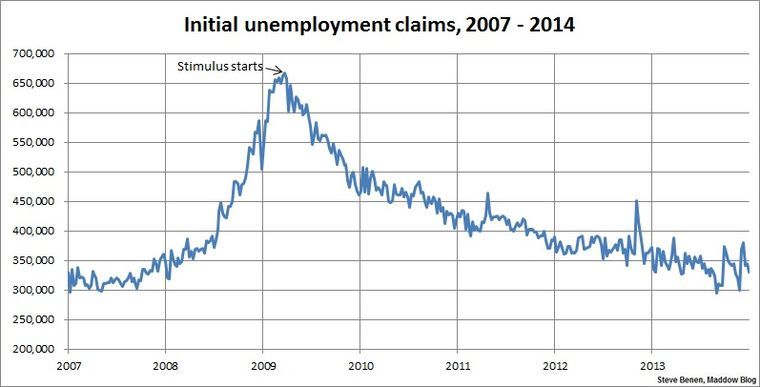
284,000, the lowest number of claims in 8½ years, the 4 week moving average fell to 302,000, the lowest level in 7 years, and continuing claims falling by 8,000 to 2½ million.

Not too shabby.

Thursday, May 8, 2014

It's Jobless Thursday!

Initial claims are down for the first time in 4 weeks, to 319K, with the 4-week moving average rising, and continuing claims falling.

Not were what it means, with various holidays and spring break making the past few weeks kind of hard to draw a bead on.

Thursday, May 1, 2014

And Our Economic Clusterf%$# Continues

First, initial unemployment claims unexpectedly rose, and then the 1st quarter GDP growth number came in with an anemic 0.1% annual growth rate, though the Federal Reserve still saw fit to continue its taper of quantitative easing.


Seriously, with inflation at next to nothing, and long term unemployment a plague, and everyone is worried about non-existent inflation.


Bah.

Thursday, March 6, 2014

It's Jobless Thursday

323K with the 4-week moving average and continuing claims falling as well.

Not bad.

Thursday, February 20, 2014

It's Jobless Thursday!

Jobless claims fell slightly, while the 4-week moving average rose slightly.

More significant might be the small improvement in the Index of Leading Economic Indicators.

Given the recent weather though, I'm not sure how reliable any of this data is though.

Thursday, January 16, 2014

It's Jobless Thursday!!!!

Numbers are decent, initial claims down 2,000 to 326,000, the 4-week moving average fell by 13,500 to 335,000, though continuing claims rose by 63,500 to 1.35 million.

OK, but not great.

Friday, January 10, 2014

Uh-Oh………


Labor force participation rate
It looks like the Fed was a little bit premature in its decision to ease off quantitative easing:
Today’s U.S. unemployment figures were surprisingly bad. Only 74,000 jobs were added to payrolls in December, barely half what analysts had expected. The news was a reminder of how far from normal the economy still is -- and of how tricky it will be for Janet Yellen, who’s about to take over as chairman of the Federal Reserve, to explain the central bank’s policy.

That jobs number by itself is more worrisome than alarming. It’s a noisy statistic, subject to seasonal disturbances and big revisions. But it can’t be dismissed, either. It’s enough to suggest that the economic acceleration that looked to be getting under way in recent months isn’t yet a done deal. Some of the markets’ recent enthusiasm on that score needs to be reined in - - and, thanks to these numbers, it will be.

At first sight, the big fall in the unemployment rate to 6.7 percent from 7 percent tells a much happier story. Sadly, no. The fall reflects a further drop in the number of people looking for work. A shrinking labor force reduces the economy’s productive capacity, to say nothing of the effect on the dropouts’ prospects. And the proportion of long-term unemployed -- the workers most at risk of dropping out of the jobs market in future months -- remains close to 40 percent of the total.

In one way, the implications for policy are clear: This is no time to be tightening either fiscal or monetary policy. Extending unemployment benefits, which already made sense on economic and humanitarian grounds, is now all but mandatory. If this can be financed by extra borrowing rather than by offsetting cuts in other spending, so much the better: Some new fiscal stimulus, however modest, wouldn’t go amiss.

The bad jobs news will make the Fed think twice about its plan to phase out asset purchases -- the policy of quantitative easing, which it has been using to supply unconventional monetary stimulus. Until better numbers come along, this policy may be paused or even reversed, a possibility Chairman Ben S. Bernanke mentioned in his last news conference. Financial markets will also expect a delay in any decision to start raising interest rates. On news like this, the Fed will want to avoid any suspicion of wishing to tighten monetary conditions.
It is true that these numbers can be volatile, but it has to give the Federal Reserve a case of gas.

Thursday, January 9, 2014

It's Jobless Thursday!

The initial unemployment claims numbers are out, with initial claims falling by 15K to 330K, and the 4-week moving average falling to 349K.

Continuing claims increased by 50K to 2.87 million, and as to extended claims, there are none, because the House let extended benefits expire.

Thursday, December 12, 2013

It's Jobless Thursday!!

Jobless claims spiked last week, up 68,000 to 368,000.  (Seasonally adjusted)

So this week's was 368K, last week was 300k (revised upward by 2K), and the week before that was 321,000.

What this all means is that we are having issues with the seasonal adjustment.

Thursday, December 5, 2013

It's Jobless Thursday!!!!!

Initial unemployment claims fell to below 300,000, 298000, beating expectations, though the holidays have a lot of noise in there.

More significantly, 3rd quarter GDP was revised upward by a large amount:

The U.S. economy grew faster than initially estimated in the third quarter but weak demand and a pile-up in business inventories buoyed the case for the Federal Reserve to keep up its bond-buying stimulus for now.

Gross domestic product grew at a 3.6 percent annual rate instead of the 2.8 percent pace reported a month ago, the Commerce Department said on Thursday.

It was the biggest gain since the first quarter of 2012, but inventories accounted for almost half of the increase in growth.

"The strong third-quarter growth pace masks the more subdued tone in domestic activity, and as the bloated level of inventory is worked off, we are likely to see a much softer performance in growth in the fourth quarter," said Millan Mulraine, senior economist at TD Securities in New York.
So, what happened was that more stuff was made, but it just filled up warehouse shelves.

The holiday shopping season could be make or break for the economy.

Wednesday, November 27, 2013

It's Jobless Thursday on Wednesday

Pretty decent numbers, though with the rush to get iut our ahead of Thanksgiving, I would wait for the update in a week.

Thursday, October 17, 2013

No Initial Jobless Claims for You!

There are numbers, but the government shutdown makes them totally unreliable.

Have a funny:

Thursday, October 10, 2013

It's Jobless Thursday

And the numbers suck, but as with the past few weeks, there are computer/reporting issues, so the accuracy is suspect:

Claims for U.S. jobless benefits jumped last week to the highest level in six months, providing the first statistical warning that the damage from the partial federal shutdown is starting to ripple through the economy.

While half the increase came from California as the state worked through a backlog following a switch in computer systems, another 15,000 reflected the furlough of non-federal workers from employers losing government business, a Labor Department spokesman said as the data was released to the press. Applications (INJCJC) for unemployment insurance benefits surged by 66,000 in the week ended Oct. 5 to 374,000, the most since late March, figures from the Labor Department showed today in Washington.
Hopefully, we will start seeing some "normal" numbers in the next few weeks.